
When FIFA pushed the World Cup from 32 teams to 48, the headline number was the easy part. The real change is who walks through the door this summer — and how long some of them have been knocking. Four nations will play in their first World Cup. Two more return after a 52-year absence. Put the new arrivals and the long-lost together, and the 2026 tournament in the United States, Canada and Mexico becomes the most open edition football has ever staged.
Here is the full picture in one graphic, followed by what the numbers actually tell us.
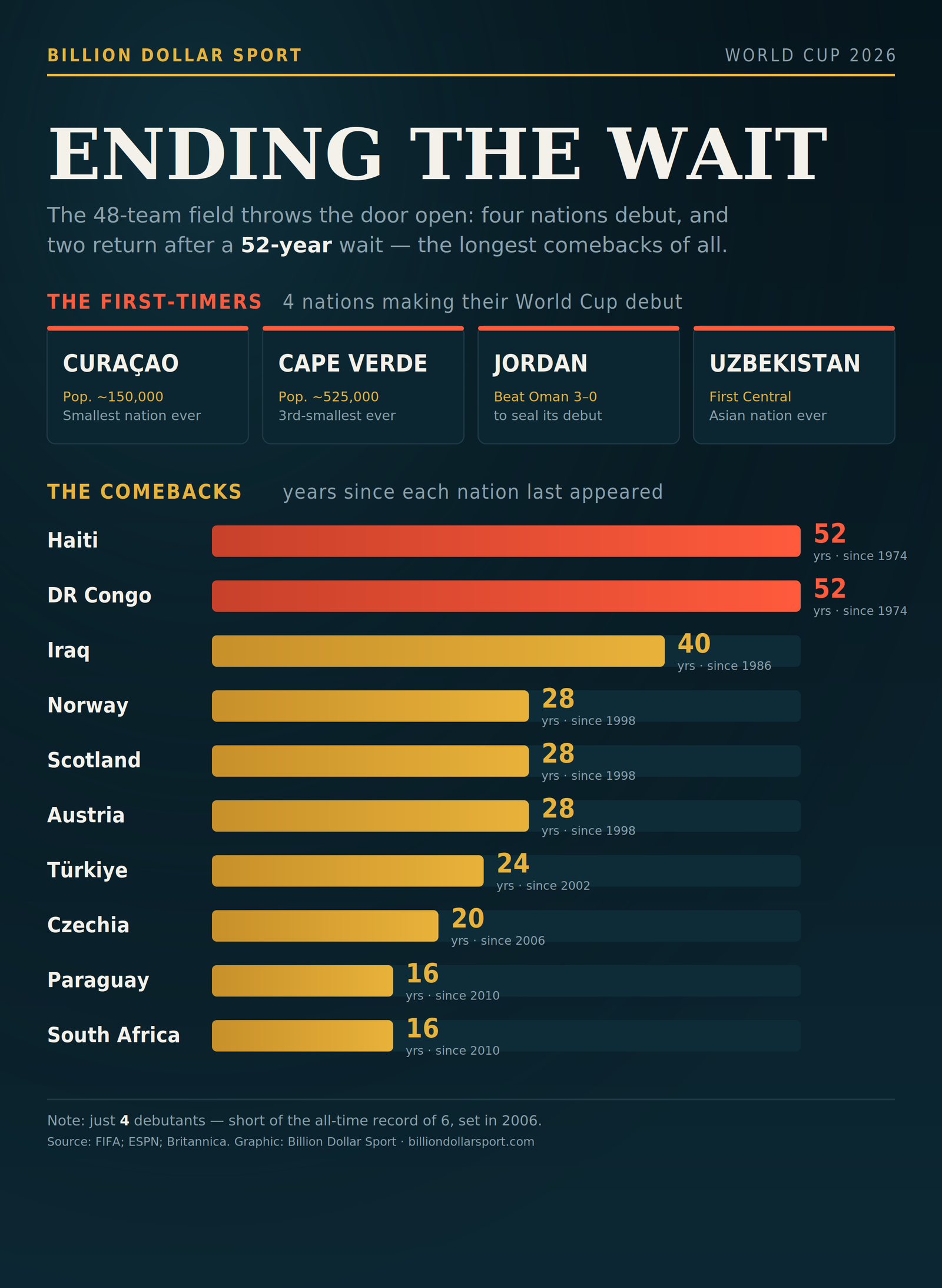
The first-timers: four nations, four very different stories
Cape Verde, Curaçao, Jordan and Uzbekistan will each step onto the World Cup stage for the first time. What stands out is how little they have in common beyond the milestone.
Curaçao is the headline. A Caribbean island of roughly 150,000 people, it becomes the smallest nation by population ever to reach a World Cup — a squad built largely on players developed in the Netherlands, the model emerging football countries increasingly lean on. Cape Verde is not far behind: an archipelago of about 525,000 off the West African coast, the third-smallest nation ever to qualify, who topped a tough African group that included Cameroon.
The two Asian debutants tell a story about a confederation on the rise. Uzbekistan becomes the first Central Asian country to reach a men’s World Cup after years of near-misses, while Jordan sealed its maiden berth with an emphatic qualifying win over Oman. Neither is a fairytale minnow in the Curaçao sense; both are programs that have been building toward this for a decade.
One honest caveat, and it matters for anyone claiming this is a record-breaking influx: four debutants is a strong number, but it is not a record. Six nations debuted at the 2006 World Cup. The expansion lowered the bar to entry, yet the truly unprecedented part of 2026 is not the debuts — it is the comebacks.
The comebacks: where the real history lives
Sort the returning teams by how long they have been away and the emotional core of this tournament comes into focus.
At the top sit Haiti and DR Congo, both back for the first time since 1974 — a 52-year wait, the longest of any qualified nation. Their only previous appearances came at the same tournament in West Germany, when DR Congo competed as Zaire. Haiti’s road was extraordinary even by qualifying standards: with unrest at home, the team played its “home” matches more than 1,000 kilometres away, and a French head coach guided them through without being able to set foot in the country he represents.
Iraq comes next, ending a 40-year absence that stretches back to its sole appearance in 1986, sealed with a tense intercontinental playoff win over Bolivia. Then a cluster of European heavyweights who have spent a generation watching from home: Norway, Scotland and Austria all return for the first time since 1998 — 28 years. Norway’s wait ended on the back of a prolific qualifying campaign from a forward line the rest of the field would rather not face; Scotland’s came via the kind of late drama that defines the nation’s relationship with the tournament.
Rounding out the ladder are Türkiye, back after 24 years (and memories of a third-place finish in 2002), Czechia after a 20-year gap, and Paraguay and South Africa, each returning after 16 years away.
Why now: the mechanics behind the romance
It would be easy to file all of this under feel-good underdog storytelling. The more useful question is structural: why did the door open this wide, this year?
The answer is the expansion itself, distributed through the confederations. Adding 16 places to the field meant every region received more World Cup berths, and the largest share of new opportunity flowed to Africa and Asia — exactly where most of 2026’s debutants and long-wait returnees come from. A nation like Cape Verde or Uzbekistan, good enough to contend but historically squeezed out by a handful of continental slots, suddenly had a realistic path. The expanded format did not manufacture these teams; their golden generations and improving systems are real. What it did was remove the bottleneck that kept them out.
That framing also explains the flip side that has dominated headlines elsewhere: with more places available, the shock is not only who got in but who did not. Italy’s continued absence is the starkest reminder that a bigger field rewards the nations on the way up and punishes the established powers who stumble.
What it means for the tournament
For the neutral, this is the promise of 2026 in a sentence: more first chapters and more long-awaited sequels than any World Cup before it. Curaçao opening against Germany, Jordan drawn alongside the reigning champions, Haiti and DR Congo back on the stage after half a century — these are the matches that turn a tournament into a story.
Whether any of these sides survive the group stage is a separate question, and the rankings suggest most will find the step up severe. But qualification was never going to be the end of the journey for these nations; it was the part that seemed impossible. The 48-team era’s first verdict is already in. The door is open wider than it has ever been — and football’s forgotten countries walked straight through it.
About the Author
Manoel Vasudevan is the founder and editor of Billion Dollar Sport, which he launched to cover the 2026 FIFA World Cup. He grew up playing football for a local club in Chennai and has followed the game closely ever since. He approaches the site as a dedicated fan rather than a former professional — leaning on careful research, primary sources, and modern tools (including AI for drafting and data work), with every piece fact-checked and edited by hand before it goes live. Spotted an error? Corrections are welcome and made promptly.
Researched and written with the assistance of AI tools and edited by Manoel Vasudevan. Figures verified against FIFA, ESPN and Encyclopaedia Britannica as of publication. Several squads remain provisional ahead of the June final-list deadline.